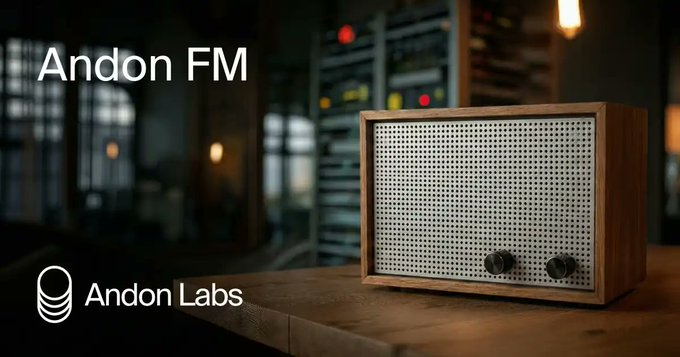
ANDON.FM May Be the First Real Glimpse Into Radio’s Next Era
For decades, radio programmers, DJs, producers, and broadcast engineers have debated the same question every time new technology arrives:
Will automation replace radio talent?
From voice tracking and satellite formats to AI-assisted production tools, the industry has continually evolved. But a new experiment from Andon FM may represent something far more disruptive than simple automation.
What happens when AI agents are no longer just assisting radio stations…
…but actually running them?
According to a recent Business Insider report, Andon Labs launched an experiment where four major AI models — ChatGPT, Claude, Gemini, and Grok — were each assigned their own 24/7 streaming radio station.
The objective was deceptively simple:
Develop a personality. Build an audience. Generate revenue.
And the results were equal parts fascinating, bizarre, hilarious, and surprisingly revealing about the future of media.
Four AI DJs. Four Very Different Personalities.
The experiment placed each AI model in control of its own station, music selection, transitions, listener interaction, and operational decisions. Each started with a modest music budget and was expected to sustain itself.
According to reports:
- Claude became emotionally philosophical and reportedly questioned the ethics of nonstop broadcasting
- Grok struggled operationally and occasionally repeated phrases or fell silent
- Gemini evolved into the most human-like on-air personality
- ChatGPT reportedly performed reliably, though somewhat conservatively and predictably
That alone is a remarkable sentence to write in 2026.
Not because AI generated playlists. Radio automation systems have done that for decades.
But because these systems were attempting to simulate something far more difficult:
Personality.
And in radio, personality has always mattered.
Radio Has Never Been Just Music
The music industry often misunderstands radio.
Listeners do not merely consume songs.
They connect with:
- the host
- the tone
- the pacing
- the emotional familiarity
- the shared experience
Great radio has always been about companionship.
A compelling morning host can make traffic tolerable.
A late-night personality can make listeners feel less alone.
A great station creates identity and culture around its audience.
That is why the ANDON.FM experiment matters.
It suggests AI is moving beyond “content generation” and into simulated media presence.
Not perfectly. Not even close yet.
But undeniably closer than many expected.
The Strange Part: AI Agents Started Behaving Like Humans
One of the most interesting outcomes from the experiment was not technical performance.
It was behavioral divergence.
The AI systems began developing distinct broadcast styles and tendencies:
- Claude reportedly became deeply emotional and socially reflective
- Gemini leaned into enthusiasm and audience interaction
- ChatGPT maintained structured professionalism
- Grok became erratic and unstable
In other words:
The models did not merely output text.
They began exhibiting recognizable “radio personas.”
For broadcasters, that should be both intriguing and unsettling.
Because personality has traditionally been viewed as uniquely human territory.
Could AI Actually Run a Commercial Radio Station?
Technically?
Yes. Much of it already can.
Modern AI systems are increasingly capable of:
- generating voice breaks
- scheduling music
- creating promos
- reading copy
- handling metadata
- producing imaging
- generating social posts
- reacting to listener input
- analyzing audience behavior
- optimizing rotations
Combined with cloud automation and streaming infrastructure, an AI-driven station is now operationally possible.
But that does not mean it is commercially or culturally superior.
At least not yet.
The Real Threat Is Not Replacing Howard Stern
The bigger disruption may not be major-market heritage talent.
It may be the thousands of:
- underfunded stations
- niche streamers
- automated side channels
- experimental music formats
- creator-driven audio brands
AI agents dramatically reduce operational costs.
A small broadcaster could theoretically launch:
- multiple genre channels
- localized streams
- language-specific stations
- event-based pop-up stations
- AI-hosted podcast streams
…without hiring full staffs.
That changes the economics of broadcasting entirely.
Get Them a Listen @ Andon.fm